
Funny How Things Work Out: Okorie “OkCello” Johnson and the Music That Found Him Back
By P. Faith Carmichael / NEXT
Publish Date: January 19, 2026
As a young artist — before his name lit up marquees across the city and the country — Atlanta-based cellist Okorie Johnson’s creative map criss-crossed the Old Fourth Ward. He bought his strings from Voss Violins, just across from what is now Dancing Goats. He forged his first collaborations with musicians out of Speech’s old studio on Edgewood, played his first outdoor gig on the Atlanta BeltLine, and recorded early projects at 800 East, a neighborhood studio off of Highland Avenue that still feels like home. He shopped at Murder Kroger. Ate at Eats. Rehearsed, recorded, and performed in and around the corridor long before it was lined with cranes.
“So much of my creative life — the origin of it — is in that part of the city,” he says. “It was hard to be a creative and not be there. It was where everything was happening.”
By the time he was in his 30s, he’d been a filmmaker, a teacher, and a man with a cello chasing a dream always a little out of reach — until one day in December 2014, on his 40th birthday, the chasing stopped. Sitting in his home studio, not sure how to keep going as a full-time artist but not ready to quit, he picked up his cello and looped a bassline. And then he looped again. And again. Until something cracked open. Until the tears came.
By the time he finished, he was sobbing. Shirt soaked, shoulders heaving. “It changed my life,” he says now. “I had stumbled onto something more honest than I’d ever written.”
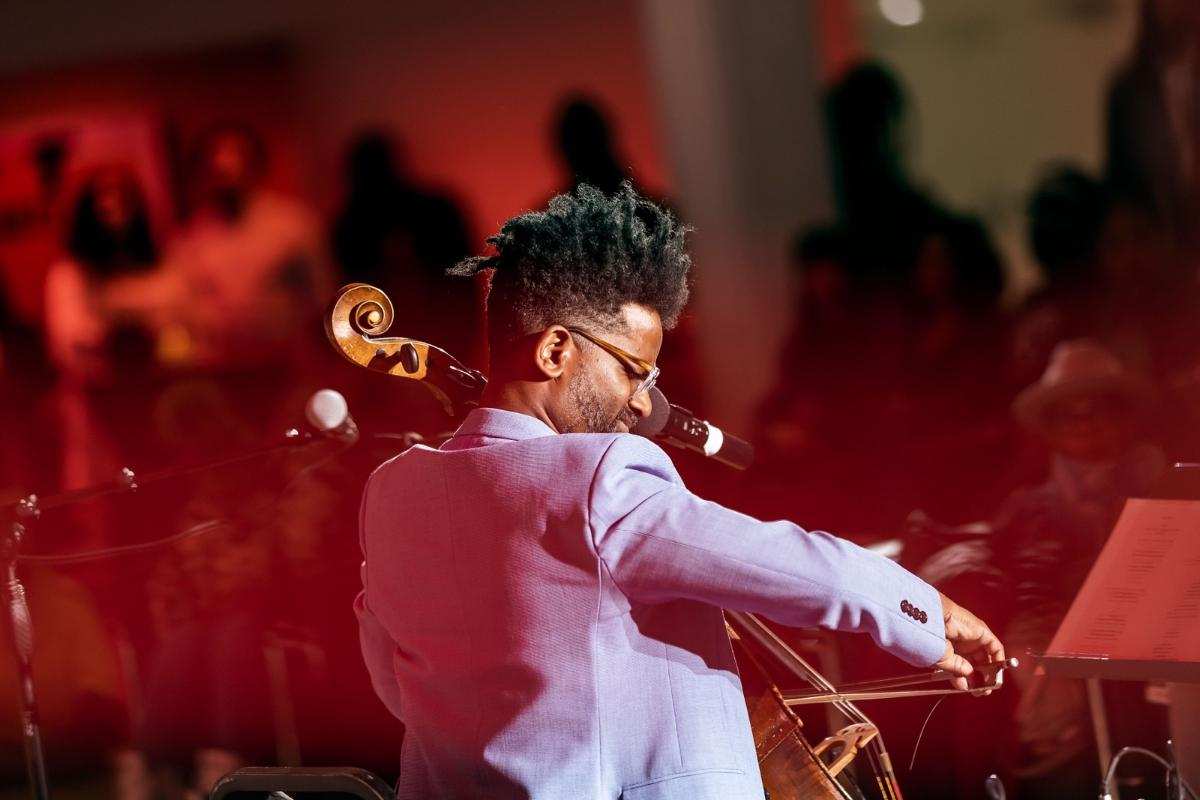
That single musical phrase, although unplanned and unscored, became the root of a new song. That song became a performance. And that performance became a year-long practice of monthly shows, each one a public act of self-discovery. By the end of 2015, Okorie was no longer working inside other people’s visions — he had finally built his own. That was the start of OkCello.
From that quiet moment of self-trust, his career began to stretch, far across the city and beyond.
He’s since performed across the U.S. and internationally, including in London, Las Vegas, New York, and the Democratic Republic of Congo, where he was featured in the Kinshasa Biennale. He’s played Atlanta Symphony Hall, created commissioned works for the High Museum of Art, and was selected as one of six artists featured in The NEXT Movement, a PBS concert film honoring the city’s cultural vanguard. He’s scored for theater and film, contributed to gallery installations, and served as an inaugural fellow with Emory University’s Arts & Social Justice Fellows program. No matter how far the music takes him, he remains rooted in the city that gave him space to become.
A Sound All His Own
It’s hard to explain what OkCello does on his instrument without flattening it. Is it classical? Sure. But it’s also Afrobeat, soul, jazz, hip-hop — all of it, infused with the rhythms, scales, and storytelling traditions of the African Diaspora.
“I like classical music, and it’s what I first learned to play on the cello, but that wasn’t my life,” he explains. “When I wasn’t playing, I was listening to Prince. I was listening to hip hop, go-go, alternative music, folk–you name it. I realized I didn’t want to separate who I was from what I played.”
And to be clear, he doesn’t just play the cello, he loops it, layers it, bends it until it speaks to you. His music doesn’t seek to impress. It aims to tell the truth. About grief. About faith and all the tenderness and complexity of being human.
“The invitation is to bring all of yourself to the instrument,” he says. “Most classical musicians don’t play the music they actually listen to. I didn’t want to be that kind of musician.”
A City That Said Yes
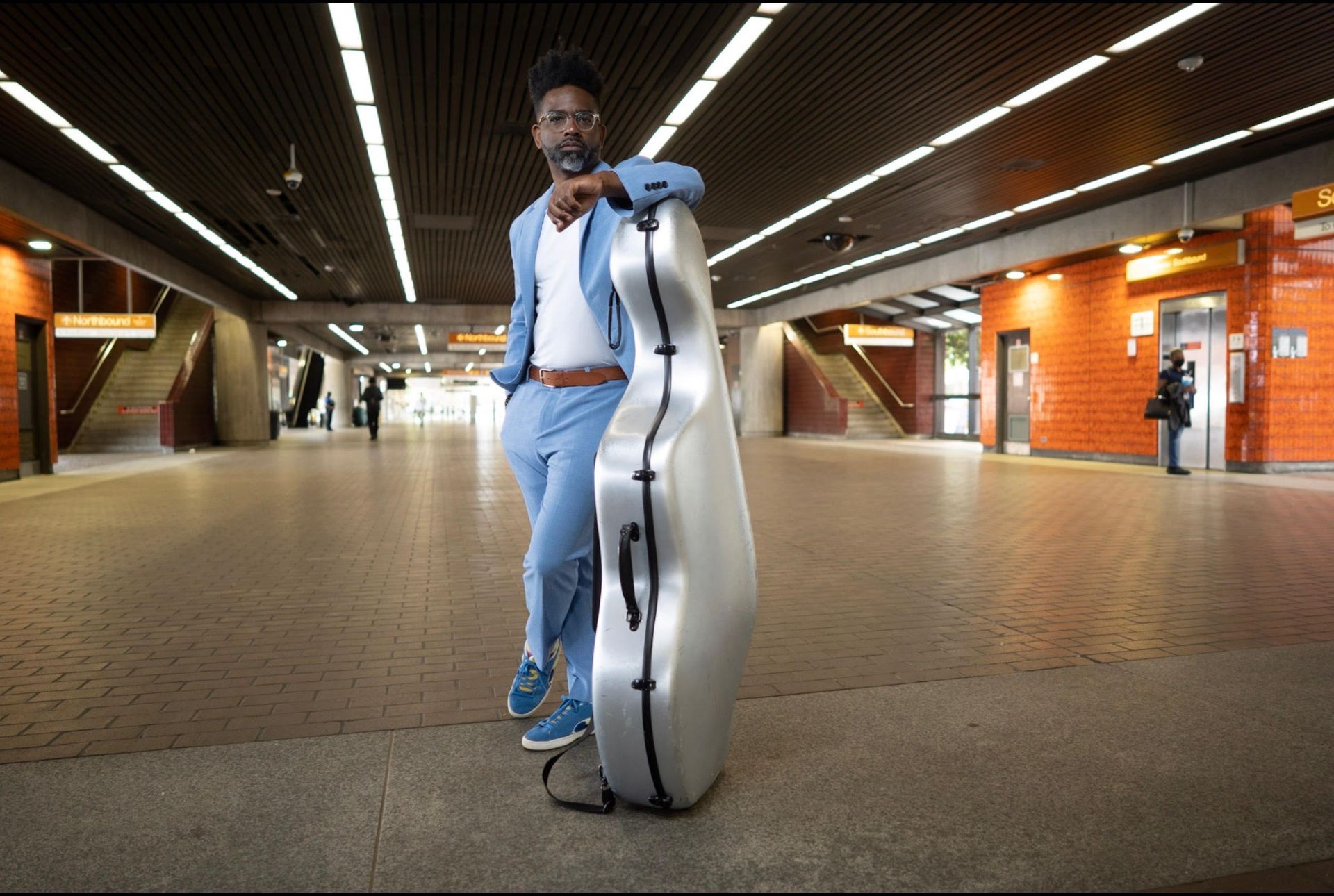
As a Black cellist trained in the Eurocentric traditions of classical music, there are few cities where Okorie’s career could have unfolded the way it did. Atlanta is one of them.
From the studio on Edgewood where he first recorded with Speech, to the band he co-founded in the 1990s while playing in Piedmont Park, to the experimental stages that let him explore sound not as entertainment but as healing – the city has been both mirror and muse.
“There’s something about the creative permission Atlanta gives you as a Black creative,” he says. “This city embraced my unique, weird expression of African diasporic creativity. And I am forever grateful to it for that.”
He draws a straight line from artists like Speech and André 3000 to his own creative freedom.
“Between Speech and Dre, there’s this authentication of free Blackness here,” he says. “It gave me permission to be a soulful, improvising cellist in a folk band — and still be seen.”
That distinctiveness, he admits, was nurtured in large part in the Old Fourth Ward. It’s where he shopped, played, recorded, and found his footing as an artist. It’s also home to one of his most beloved stages: City Winery, where he’ll perform again on December 16, his birthday, and what he calls “a chance to exhale after the most intense season of my career.” This year’s performance will also mark the launch of his new album, “Funny How Things Work Out” — an eclectic blend of collaboration and exploration that is part memoir and part meditation meant to help listeners believe “the universe might be conspiring on their behalf.”
City Winery has become a kind of ritual for him. Not quite a residency, but close.
“I play there once a year, and it’s always different,” he says. “It’s my chance to look back and look ahead at the same time.”
Looking Ahead
Looking ahead, Johnson is casting his gaze beyond the city that shaped him. He has gigs lined up in Alaska, Oregon, and Las Vegas, and recently performed on a luxury yacht on an international engagement — a surreal moment for an artist who once looped cello lines in his living room, just trying to find his voice.
“While Atlanta is my home, I’m looking broadly at the world and where else OkCello can travel,” he says. “I want to play in Europe, in Africa, in Asia and bring those experiences back home.”
That home, he knows, will always be Atlanta.
And as the city continues to transform, he hopes its future is built with intention and the same creative foundation that helped elevate him in the first place.
“My experience of Atlanta is that its magic lies in its creativity,” he says. “Protect that, and we stay extraordinary.”

Let’s Connect
Have questions about BLVDNEXT? Want to learn more about opportunities for residents or businesses? Need to share your thoughts about the project? We’re here to listen.